Wednesday, January 18, 2006

Support for Greater Melbourne on the increase

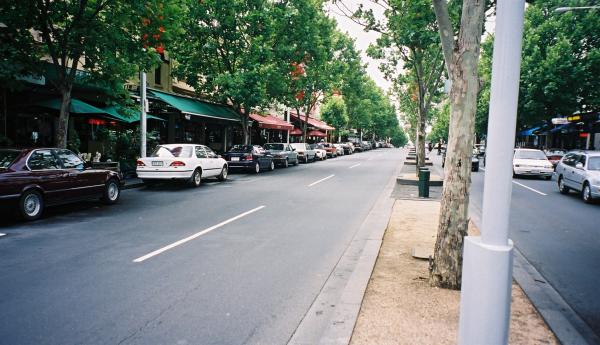
Proposed merger with City of Yarra, Port Philip and former City of Prahran. Communites reunited

The City of Melbourne should be merged with the City of Yarra, the City of Port Philip and the former City of Prahran - with adjustment to external boundaries to reunite the Kensington and Carlton communities.

Following our earlier post last year in discussion and feedback received there is growing support and desire for more public debate about the merits and feasibility of expanding Melbourne City Council's boundaries. Support for the proposal is growing. Councillors, past and present, associated with the City of Melbourne, City of Yarra, Port Philip and the former City of Prahran have supported the idea and are calling for more public debate. Residents of the Prahran electorate in particular are not happy with the level of services delivered by the City of Stonnington and would favour a merger with the City of Melbourne where there is a greater community of interest.

There are clear economic benefits from such a change. The question is will the State Government consider any changes to the municipal boundaries and encourage further public debate?

Sunday, January 15, 2006

The Kiss of Death -- Doyle gets Costello vote

As the Liberal Party continue to slag it out in public they lose overall support

Peter Costello is sounding more and more like a man resigned to the fact that he is not going to get an opportunity to be PM sounding more and more like an elder statesman ready to retire.

His recent endorsement in the Age newspaper makes some sense but there is a lot more you can read between the lines.

Doyle gets Costello vote - National - theage.com.au

Robert Doyle is probably one of the better candidates on the State opposition benches (Apart from Ted Baillieu there is no other real choice). The Liberal Party is in the same position Labor was in following the 1992-1996 State elections with Robert Doyle in the same spot as John Brumby when he was thrust into the State leadership following the resignation of Jim Kennan.

I personally have some respect for Robert, having stood against him in 1992 for the seat of Malvern ( The ALP never expected to win Malvern but it was fun campaigning never the less).


Robert Doyle is not tainted with the level of corruption or degree of arrogance and self interest normally associated with the Liberal Party and overall he is considered an honest sincere member of Parliament .

A party divided is a party doomed to failure
Good Government requires a solid and effective opposition, something that is missing in Victoria and its not Robert's fault, he is not the problem it is his back bench and their constant bickering undermine the Liberal party's chance of success.

Robert Doyle, having been elected to the leadership, is constantly being let down by his own team. The best he can do is spend his time fighting it out and hope that the State election in November will see the Liberal Party win more seats with new effective hard working members of Parliament elected to bolster the overall flagging support of the State Liberal Party.

Time to move on
The sooner the Liberal Party abandon the idea that Jeff Kennett was good for Victoria the sooner they will move forward. (If any one wants to know more about Jeff and his time in office check out the pages of Crikey.com.au - Steven Mayne, a former member of Kennett's staff, had all the inside goss and goings on related to Jeff's managenment of Victoria)

The Liberal Party have a real chance this election of gaining control of the Victorian Upper House which in turn will ensure that the Bracks Labor Government will be held accountable. (See analysis of the 2005 Senate Election)

Its not going to be easy, the more the State Liberal Parliamentary Party keep bickering the worst its going to be. They could even go backwards, if that is at all possible. The electorate does not like division and in-fighting, it serves no one other then the State Government who are looking pretty good by comparrison.

Adding to Robert's woes is that the Bracks Government have been responsible and unlike Jeff Kennett have not abused their position of power and control of both houses of Parliament. As such they continue to enjoy overall community support.

The job facing Robert Doyle is difficult. It's never easy when you have to spend most of your time defending off attacks from your own team.

Its time for a clean out - fresh new blood with ideas and ability

The Liberal Party needs to act quickly and show some internal discipline by dis-endorsing those members that constantly undermine the State Parliamentary Liberal Party. They must show solidarity and support for their leader and his efforts to work on regaining the public's confidence and lost support.

State Liberal Party Parliamentarians would better serve the interest of Victoria and their supporters if they spent more time developing meaningful policy then slagging each other in the media at the every possible opportunity. Their policy on local government and accountability is non existent.

Game on


Anthony van der Craats

Saturday, January 14, 2006

Missing but not forgotten - Melbourne's heritage worth preserving

What happened to Melbourne's veranda policy?

What ever happened to Melbourne's veranda policy?
The City of Melbourne in response to community concern at the need to protect and restore Melbourne's inner city Victorian streetscapes commissioned heritage architect Meredith Gould to develop a veranda policy. The policy document written by Ms Gould was well received and supported by the City Council who adopted the document as a planning guideline for Melbourne's future development.

Prior to the adoption of this policy City of Melbourne's Rob Adams wanted to approve the construction of a number of private balconies above the foot path in Lygon Street. Rob Adams had approved similar balconies in Swanston Street. (Swanston Street's Victorian verandas were removed, in the lead-up to the 1956 Melbourne Olympic Games, as part of its modernisation programme.)
The construction of above the footpath balconies would have been the death of Lygon Street's Victorian streetscape as historic verandas would have be demolished to make way for Rob's folly in urban design and town planning.

Thankfully we were in a position at the time to put a halt to this act of vandalism proposed by the City of Melbourne's Urban Design department.
The policy document produced by Meredith Gould saw the City of Melbourne take a more positive and constructive approach to preserving Melbourne's architectural history which has since seen a number of Lygon street's heritage verandas restored, adding to the ambiance of this world famous tourist precinct.

Strangely the Council's policy document can not be found anywhere on the City Council's web site. Missing but not forgotten. Could it be that Rob Adams is just bidding his time hoping that the community will forget about this policy document that was incorporated into Melbourne's Planning scheme would be forgotten so he could yet again propose the destruction of Melbourne's Victorian heritage?

We call on the City Council to publish this document along with other planning guidelines on it web site without delay.

The changing wind in Lygon Street Trees

Will bamboo Rob axe the trees?

It all depends on which way the wind blows

The Herald-Sun ran a bit of a beat-up cut them down storey on Connie Paglianiti and her phobia about Plain Trees in Lygon Street. This storey has been around for years and Connie runs with it every year. Thankfully she has little support but you can never tell with Melbourne Greens Fraser Brindley, he is renowned for policy back-flips and selling out his constituents on policy issues.

The fact is the plain trees are not as huge a problem as Connie makes out. Those dinners and cafe latte drinkers that do not like dining outdoors can always go inside and enjoy the comfort of an air-conditioned environment. It would be a surprise, but not out of the question, for Mr integrity Rob Adams to support the cutting down of 180 plain trees in Lygon Street, at considerable cost to the City, but you can never tell which way the wind blows with bamboo Rob.

The Lygon Street Traders are never happy unless there is something to complain about and the Traders' Association certainly does not represent a majority of Lygon Street Traders on this issue.

The main reason that the Lygon Street Piazza was never developed earlier is they could never agree on the design. Melbourne City Council had employed a brilliant Landscape Architect, Ron Jones, who originally came up with what I considered to be a low cost innovative development design for the site - only to find that the Lygon Street Traders Asscoiation were not of the same opinion.

Those who are interested in the Tree debate should check out Andrew Landeryou's The Other Cheek take on it all.

Analysis: Victorian Senate vote 2004 to new Legilsative Council regions

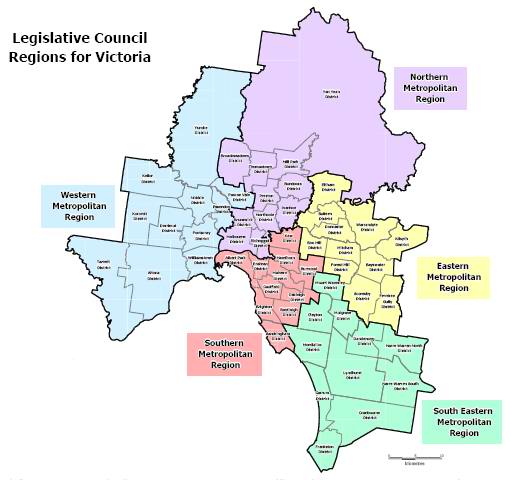
Analysis of the 2004 senate vote based on the new Legislative Council boundaries

Being interested in electoral reform we thought it would be of some general interest and value to do an analysis of the 2004 Victorian Senate vote as it would apply to the new Legislative Council boundaries.

We chose the Senate because it provides an opportunity to access the relative strength of all the main political parties who nominated candidates for the Senate (The National Party had a joint ticket with the Liberal Party). This analysis is not 100% accurate as the preference negotiations and registered party allocations would be significantly different under the new eight electorate model but never the less we consider it worth reflecting on.

In our analysis we allocated and distributed the vote according to the registered "above-the-line" preferences for the 2004 Senate elections. No assessment has been made at this stage to consider the impact of below the line voting (This may effect the outcomes of the last position elected. We are waiting on further information from the Australian Electoral Commission which would enable more detailed analysis to be undertaken.


Analysis (Modified to reflect McGauran's defection to thw Liberal party)

Based on the 2004 Senate result our analysis indicates that the Liberal/National Party coalition would have obtained an absolute majority (21 out of the 40 members) of the Legislative Council.

Results
Eastern Metropolitan Region (Lib, ALP, Lib, ALP, Lib)
Eastern Victoria Region (Lib, ALP, Lib, ALP, Lib)
Northern Metropolitan Region (ALP, Lib, ALP, Lib, Grn)
Northern Victoria Region (Lib, ALP, NP, Lib, ALP)
Southern Metropolitan Region (Lib, ALP, Lib, NP, Grn)
South Eastern Metropolitan Region (Lib, ALP, Lib, ALP, FFP)
Western Metropolitan Region (ALP, Lib, ALP, Lib, ALP)
Western Victoria Region (Lib, ALP, Lib, ALP, NP)


Sum
ALP (16) - (32.27%, 30.66%, 42.82%, 27.11%, 27.15%, 39.71%, 48.50%, 35.21%)
Liberal (18-19) - (49.11%, 50.45%, 33.38%, 53.50%, 49.93%, 42.65%, 33.39%, 46.76%)
National Party (3-2) *
Green (2) - (8.33%, 7.59%, 13.28%, 5.39%, 15.01%, 6.43%, 6.24% ,7.39%)
Family First (1) - (2.17%, 2.46%, 1.25%, 2.61%, 0.78%, 2.25%, 1.55%, 2.11%)

* the Liberal/NP ran on a single ticket with the NP listed no 2

Addendum (21-24 January 2006)

Please Note: The Liberal/National Party stood on a single ticket with the National Party listed at second place. For the purpose of the analysis the Liberal Party and National Party are considered one. In the case of non rural seats it is the Liberal Party support that contributes most to the outcome of the analysis.

The recent defection of Julian McGauran from the National Party to the Liberal Party would reduced the National support to two-three seats. Previously seats that would have been won by the Liberal Party were allocated to the National Party as they held the number two position on the coalition ticket. I have now reallocated those seats back to the Liberal party.

Some readers have not understood this fact. I thought that it was pretty obvious in the analysis listed above.

Clearly not to some. If the Liberal/National Party continue to run a joint ticket with the National Party second on their ticket then the National Party would win the second spot as indicated assuming all else is equal. Again This is a preliminary analysis and more detailed analysis is pending receipt of additional information requested by the Australian Electoral Office (Including below the line data).

2004 Victorian Senate Vote

Distribution Graph


Yarra River point of division not unity

City Council split down the middle. New boundaries 'Gerrymander' will hand control to Liberal Party

The Victorian Electoral Commission - Electoral Boundaries Commission late last year released its findings and recommendations on the electoral boundaries for Victoria's Legislative Council.

Under the reform introduced by the Brack's State Government - Victoria's Legislative Council (Upper House) will be elected by a multi-member proportional representation system similar to the system used to elect the Australian Senate. Whilst this overall is a step in the right direction and long overdue there are a number of disappointing aspects to the outcome and details of its implementation.

City Melbourne split with the Yarra River continuing to be point of division.

The City of Melbourne once again will be divided into numerous State Electorates with the Yarra River being a point of division not unification.

Disappointingly the VEC commission considered in their wisdom the Yarra River to be a dividing line as opposed to a focus of unity.

The newly created electorates fan out from the Melbourne Port Philip Bay area to the outer suburbs ignoring basic community of interest criteria lumping inner urban and outer suburban electorates together. Melbourne Province prior to 1988 crossed the Yarra and encompassed the electorates of Prahran, Albert Park, Richmond and Melbourne- the Yarra River being a central focus of the electorate. Not a word or an utterance by the City Council who failed to make a submission or express a view on the proposed boundaries. They could have advocated that the Commission seek to ensure that the City of Melbourne was incorporated into a single electorate instead of being divided. Melbourne has more in common with Albert Park and Prahran then it does with Yan Yean, Mill Park or Ivanhoe.


Alternative model

One of the models under review in the 1990's when the ALP first seriously considered the issue of reform of the Upper House, as opposed to its previous policy of abolition, was to divide the State into five electoral regions. (Two rural and three inner-urban. This model would have provided a Legislative Council based on a 5 x 7 member with a quota of 12.5% or a 5 x 9 member on 10% quota.)

The five electoral regions model would have had one central inner urban electorate and two, north-western and south-eastern outer urban electorates with two rural electorates east and west of the Hume corridor.

This model overall would have produced a better outcome then what is currently in place.

It would have required a reduction in the number of Lower House seats from 88 seats to either 85 or 75 seats.

The main advantage of the five district model was that it facilitated a better community of interest makeup then what is currently in place. With the Yarra river being a point of unification and not division.


One-vote one-value principal ignored

Other issues of concern relate to the method used to elect representatives. The method of election is similar to that used to elect the Senate and some local councils, including the City of Melbourne.

One of the problems with the current system is that the method used to calculate the proportional transfer of votes seriously distorts the one-vote one-value principle. The system currently used increases the value of major parties vote whilst devaluing votes for minor candidates. This can and will effect the outcome of the election.

The formula used to calculate the transfer value is outdated, designed back in the days of manual counting in order to make it easier to count. It is based on the value of candidates surplus divided by the number of ballot papers that are allocated to the candidate, irrespective of the value of the ballot paper received. A ballot paper with the value of one is transferred at same value as a ballot paper that has a much lower value that was previously distributed, effectively reducing the value of one vote and increasing the value of the vote that has already been counted and transferred.

The state government is aware of this deficiency in the adopted system. The change required to fix it is minimal. Instead of calculating the proportional value based on the number of ballot papers it should be calculated on the allocated value of the ballot paper being transferred.

The Senate system also needs to be reviewed. The problem with the Senate system is it uses the same value distorting formula. The main difference between the Senate and Legislative Council and local government (including the City of Melbourne) is that the effect of this distortion is magnified in smaller based electorates where a lessor number of votes can determine the final outcome.

We need to ask ourselves what is more important? A system based on the principle of one-vote on-value or a system designed to standardise and ease the method of manual counting of the vote?

The fact is that the counting of the election will not be done manually but by computers. As such we should modify the system used to ensure that all votes are equal in value.


Analysis of the 2004 senate vote based on the new Legislative Council boundaries

Being interested in electoral reform we thought it would be of some general interest and value to do an analysis of the 2004 Victorian Senate vote as it would apply to the new Legislative Council boundaries.

We chose the Senate because it provides an opportunity to access the relative strength of all the main political parties who nominated candidates for the Senate (The National Party had a joint ticket with the Liberal Party). This analysis is not 100% accurate as the preference negotiations and registered party allocations would be significantly different under the new eight electorate model but never the less we consider it worth reflecting on.

In our analysis we allocated and distributed the vote according to the registered "above-the-line" preferences for the 2004 Senate elections. No assessment has been made at this stage to consider the impact of below the line voting (This may effect the outcomes of the last position elected. We are waiting on further information from the Australian Electoral Commission which would enable more detailed analysis to be undertaken.


Analysis (Modified to reflect McGauran's defection to thw Liberal party)

Based on the 2004 Senate result our analysis indicates that the Liberal/National Party coalition would have obtained an absolute majority (21 out of the 40 members) of the Legislative Council.

Results
Eastern Metropolitan Region (Lib, ALP, Lib, ALP, Lib)
Eastern Victoria Region (Lib, ALP, Lib, ALP, Lib)
Northern Metropolitan Region (ALP, Lib, ALP, Lib, Grn)
Northern Victoria Region (Lib, ALP, NP, Lib, ALP)
Southern Metropolitan Region (Lib, ALP, Lib, NP, Grn)
South Eastern Metropolitan Region (Lib, ALP, Lib, ALP, FFP)
Western Metropolitan Region (ALP, Lib, ALP, Lib, ALP)
Western Victoria Region (Lib, ALP, Lib, ALP, NP)


Sum
ALP (16) - (32.27%, 30.66%, 42.82%, 27.11%, 27.15%, 39.71%, 48.50%, 35.21%)
Liberal (18-19) - (49.11%, 50.45%, 33.38%, 53.50%, 49.93%, 42.65%, 33.39%, 46.76%)
National Party (3-2) *
Green (2) - (8.33%, 7.59%, 13.28%, 5.39%, 15.01%, 6.43%, 6.24% ,7.39%)
Family First (1) - (2.17%, 2.46%, 1.25%, 2.61%, 0.78%, 2.25%, 1.55%, 2.11%)

* the Liberal/NP ran on a single ticket with the NP listed no 2

Addendum (21-24 January 2006)

Please Note: The Liberal/National Party stood on a single ticket with the National Party listed at second place. For the purpose of the analysis the Liberal Party and National Party are considered one. In the case of non rural seats it is the Liberal Party support that contributes most to the outcome of the analysis.

The recent defection of Julian McGauran from the National Party to the Liberal Party would reduced the National support to two-three seats. Previously seats that would have been won by the Liberal Party were allocated to the National Party as they held the number two position on the coalition ticket. I have now reallocated those seats back to the Liberal party.

Some readers have not understood this fact. I thought that it was pretty obvious in the analysis listed above.

Clearly not to some. If the Liberal/National Party continue to run a joint ticket with the National Party second on their ticket then the National Party would win the second spot as indicated assuming all else is equal. Again This is a preliminary analysis and more detailed analysis is pending receipt of additional information requested by the Australian Electoral Office (Including below the line data).

Tuesday, January 10, 2006

In the name of the games. So let it be...

Bracks to open games - Lord Mayor rebuffed

In the name of the games. A right royal tiff has sprung up with three contenders to the thrown fighting it out in a public battle to see who will take the pride and honours of centre stage with her Majesty Queen Elizabeth at the opening and closing ceremonies of the 2006 Melbourne -Commonwealth Games

Link to original story
Herald-Sun

On one hand you have Australia's Prime-Minister, John Howard, who wants the job. He is close to the Queen and believes that because the Australian Government is chipping in up to $500 Million Dollars and he is the head man of the Australian Government he should be the one. Most of the money he is contributing goes towards the cost of security primarily because his governments policy and support for the war in Iraq has made Australia and the 2006 Commonwealth Games a potential terrorist target. Someone forgot to tell the PM that it is the Melbourne Games and not the Australian Games.

Steve Bracks, Premier of the Victoria, inherited the games from his predecessor Jeff Kennett who was talked into holding the games by head honcho and former head of Crown Casino, Ron Walker. Steve Bracks and his government have contributed over $800 Million and rightly so thinks he should have the honours of officially welcoming guests to the games.

And on the outside lane is our Lord Mayor, John So, the man who seriously thought the Lord Mayor should be a member of the State Cabinet. The City of Melbourne has contributed over $30 Million and Clown Hall is of the view that John So is the one who should have the role and task of official welcomer. Yes the games are the Melbourne 2006 Commonwealth Games and the City of Melbourne is one of the host organisations. HOWEVER the fact is it is the Greater Melbourne not the City of Melbourne who will host these games. Many of the games venues are not even in the City of Melbourne. The City of Melbourne were not even part of the initial organising committee and have only recently muscled in on the act.

Personally I think the games are a total waste of money and limited public resources have been re-allocated to put on this extravagant event (another one of Ron Waker's public events paid for by the public purse) and just like the Grand Prix will be a financial disaster for Melbourne but we shall not know the full cost until sometime next year well after the November State election when the glory of the event will have faded.


Right now I would be betting that Steve Bracks and his team wish the games were being held in September or October but that would conflict with the ALF and the lead up to the State Elections in November. I am sure the idea never crossed their minds.

In trying to help decide the issue as to who should be the one .... it is clear the honour and responsibility should stand with Steve Bracks representing Victoria and the Greater Melbourne Community. Both John So and John Howard will just have to contend with being in on the side lines sitting in the back row but never the less on the same stage as her Majesty.

As for me I hope to be overseas far-away from the event itself in some safer location. It is an event I have never supported and believe will prove to be both a financial and economic disaster - another one of Ron's flights of fancy. My money is on the Australian Open a truly International sporting event worthy of support. Full points for the Herald-Sun who constantly prove it is the leading newspaper in Melbourne when it comes to local issues.

game on...

Anthony van der Craats

Monday, January 09, 2006

Gambling on the revival of the City

Call for more planning control and limits on gambling

We got it wrong.... says Kirner...

Herald Sun: Labor's gamble causes regrets [09jan06]

Former Victorian Premier Joan Kirner and her cabinet express regret at their decision to introduce gambling in the State of Victoria. She and her Labor Government provided the key and unleashed gambling in an uncontrolled and unregulated manner in the hope of reviving a dying city and the state's fortune by providing a much needed cash cow.

There were no specific planning controls covering gaming. Under the roll-out of gaming machines it was possible to establish a gaming venue without a planning permit.


If someone wanted to establish an amusement parlor with more then five pinball machines they required a planning permit but if they wanted to establish or change the local hotel or restaurant into a gambling mecca palace they could do so without any community accountability or proper planning control. All that was required was a general liquor licence and the backing of Tattersall's or the TAB.

The local community or local council had no say when and under what circumstances gaming venues were established. There were limited controls related to an application for a general licence but no requirement related to the proposed use of premises for the installation and establishment of gaming machines.

Local Councils were locked-out from the process. Tattersall's and the TAB were never really held accountable and were only answerable to the Victorian Gaming Commission which was keen to support the industries growth and was removed from public eye with sessions held behind closed doors.

The Kennett government made matters worst by substantially increasing the number of gaming machines and venues without thought or consideration of the social impact and planning development of the local community. Some restrictions were voluntary imposed by Tattersall's and the TAB to protect the monopoly held by the recently established Crown Casino which dominated the city's new entertainment precinct on the banks of the Yarra river.

At the time gaming machines were first being rolled-out the local Carlton community expressed concern that Lygon Street was a potential candidate for conversion from a restaurant tourist precinct to the inner city gaming mecca. Lygon street had a number of restaurants that held a General Licence and was a prime target for a quick expansion. Fortunately for Carlton at the time Tattersalls and the TAB were more interested in targeting the outer suburban localities, predominantly in the less affluent working class regions of Melbourne, and the Premier Jeff Kennett was keen to protect Crown Casino's interests and limit the number of gaming venues in the inner city area.

There were many, myself included, who thought that the roll-out should have been done in less of a rush and that the first few years should have been restricted to non-profit social sporting clubs as was the case in NSW. But Tattersall's and the TAB duopoly wanted more control and more of the profit. Kirner wanted a quick solution in the misguided belief that her government could withstand the onslaught. Tattersall's and the TAB were working the parliamentary rooms and the only ones to escape were those that lived in Melbourne's "Dry-zone" as there were no General Licenced premises for the taking.

The question we need to ask is what can we do to stem the onslaught and impact of gaming machines and provide responsible control and limits on gambling?

We need to claw back the number of licences for gaming machines currently available.

We need to give Local Councils more say and proper control under planning regulations as to the the conditions and and circumstances gaming venues are allowed to remain or expand.

Tattersalls should be broken up into two separate divisions "Gaming and Lotteries" under separate administration and control. (If you have ever had cause to deal with Tattersall's customer service then you will understand the degree of lack of responsibility and customer care provided. It is a company that is arrogant and lacking professional standards - accountable to no-one with unchallenged ability to do what they like. They can buy governments loyalty at anytime in the knowledge that they will never be seriously challenged but of the sake of appearance endure the occasional tongue lashing.)

The Gaming commission should be merged with the Liquor Licensing commission so as to improve in the accountability and coordination between gaming and licenced venues with local Councils having more of a say in any application for a gaming/liquor licence.

Any future Gaming licences should be limited to sporting and social clubs only.

Electronic Gaming Card

We need to introduce an electronic "Gaming Card" were payment for the use of gaming machines would be limited to special electronic gaming cards only. With strict limits applying to the amount of money that can be spent by any one individual within a certain period. Similar to the limits that banks apply to credit card expenditure.


Electronic gaming cards should never provide credit and be subject to strict controls related to membership and use. An application for membership would be open to all Australian citizens and permanent residents who would be required to produce suitable identification in the form of a valid drivers licence or passport. Overseas and interstate tourists and visitors could purchase short term membership cards at a predetermined value and would also be required to provide valid identification.

The introduction of electronic gaming cards would allow more effective control and monitoring of money laundering and criminal activity.

A person would be entitled to hold only one card and all deposits and withdrawals must be via electronic bank transfer only.

An application could be made to the courts for a person to be denied access or further restriction to their right to hold a electronic gaming card.

The gaming card could be used to buy food, drink and other services provided by the authorised gaming establishment venue only.

game on...


Anthony van der Craats

Sunday, January 08, 2006

City of Melbourne administration head back to work

Its a new year and members of the City of Melbourne administration are coming back to work this week having had time off for Christmas. Some are still on holidays until after the Australia Day weekend but there Clown Hall stops for no man. They say you can never beat Town Hall. This is true they have more resources and are never held accountable for their mistakes. Whoever we have always maintained that their is a need to maintain for a constant watch over the City administration. We are a wake up to their past deeds and we hope to continue placing on the public record the issues that they do not want made public. We will be continuing this blog as a political record of the true goings on in the City Melbourne.

We welcome your comments, tips and inside information and in particular thank those members of staff that have supplied us with insider information. Rest assured that we value contribution and share you views that the Council should be held accountable for the expenditure of public funds and will at all times respect and protect your identity. All confidential sources will be referred to as the inside Elf.

For those staff that want to contact us they can do so by sending an email to Melbcity@gmail.com or just leave an anonymous comment attached to any post published on this site. The Internet is a great means of ensuring accountability though providing information. We remind staff NOT TO USE the Council's internet service. They monitor all communications. However that should not stop you from logging on at home or at the internet cafe around the corner.

All the best for the new working year...

Anthony van Der Craats